Is There Time in Heaven? What Eternity Really Means
Is There Time in Heaven? What Eternity Really Means
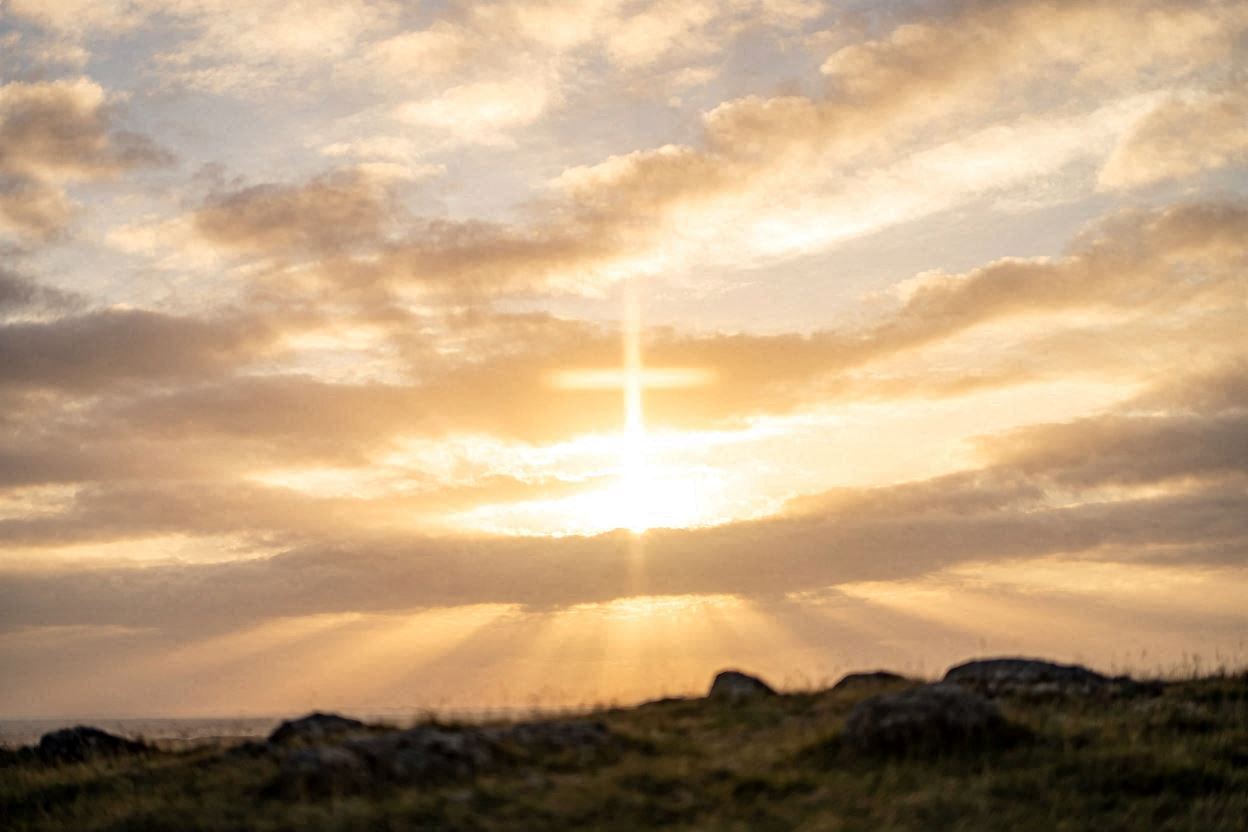
Sunset sky with a glowing cross-shaped beam of light shining through clouds above a rocky, grassy landscape
Time shapes every moment of our earthly lives. If you want a deeper foundation before we go further, you can explore a helpful overview of Heaven here.
We feel it in our aging bodies, in the pace of our days, in the deadlines that press against us, and in the quiet ache of moments we wish we could stretch just a little longer. Time moves us forward whether we are ready or not. Yet Scripture tells us that eternity is coming — a reality where time, as we know it, will be transformed.
So the question rises naturally: Will there be time in Heaven? Or does eternity mean something entirely different from the ticking clock that governs our days?
Many people imagine eternity as a kind of endless, frozen moment — a static existence where nothing changes and nothing unfolds. But that picture does not match the Bible’s descriptions of Heaven, nor does it reflect the nature of God’s creation. Understanding time in Heaven helps us understand what eternity feels like, whether we will grow and learn, how relationships will unfold, and what it truly means to live in God’s presence forever. This isn’t an abstract question. It shapes our hope.
Scripture begins by reminding us that God Himself exists beyond time. Moses declares:
“Before the mountains were brought forth, or ever thou hadst formed the earth and the world, even from everlasting to everlasting, thou art God.”
— Psalm 90:2 (KJV)
Peter echoes the same truth:
“But, beloved, be not ignorant of this one thing, that one day is with the Lord as a thousand years, and a thousand years as one day.”
— 2 Peter 3:8 (KJV)
God sees the end from the beginning in a single, unified vision. He is not bound by clocks, calendars, or aging. But humans were created within time — with memory, anticipation, sequence, and growth. Heaven does not erase our humanity; it redeems it. The real question, then, is not whether time disappears, but whether redeemed humans will experience time differently — not eliminated, but perfected.
The Bible never teaches that time vanishes in eternity. What disappears is decay. Death, aging, and corruption are removed, not the experience of sequence or movement. John writes:
“And God shall wipe away all tears from their eyes; and there shall be no more death, neither sorrow, nor crying, neither shall there be any more pain: for the former things are passed away.”
— Revelation 21:4 (KJV)

Paul adds:
“For this corruptible must put on incorruption, and this mortal must put on immortality.”
— 1 Corinthians 15:53 (KJV)
For a clearer picture of what awaits us beyond this transformation, you can look at a fuller description of what Heaven is really like.
Eternity is not timelessness. It is endless life without decay. We will not be frozen or suspended in a single moment. We will live — fully, joyfully, actively — without the shadow of death.
Scripture reinforces this by describing events in Heaven that unfold in order. Worship happens continually. John writes:
“And they rest not day and night, saying, Holy, holy, holy, Lord God Almighty, which was, and is, and is to come.”
— Revelation 4:8 (KJV)
This is sequence. This is movement. This is time — redeemed, not erased.
John also describes the great Marriage Supper of the Lamb — an event that happens at a specific moment, not an abstract timeless idea:
“Let us be glad and rejoice, and give honour to him: for the marriage of the Lamb is come, and his wife hath made herself ready.”
— Revelation 19:7 (KJV)
Moments like these require sequence. They require “before” and “after.” They require time — not the broken, rushing, decaying time we know now, but redeemed time, time without sorrow or loss.
Paul also speaks of a future moment when believers will stand before Christ to receive rewards:
“For we must all appear before the judgment seat of Christ; that every one may receive the things done in his body, according to that he hath done, whether it be good or bad.”
— 2 Corinthians 5:10 (KJV)
This is not a timeless blur. It is a real moment in the unfolding story of eternity.
Even the New Jerusalem is described as a place where nations “bring” their glory into it — an action, a movement, a sequence:
“And the nations of them which are saved shall walk in the light of it: and the kings of the earth do bring their glory and honour into it.”
— Revelation 21:24 (KJV)
Heaven is not static. Heaven is alive.
And if Heaven includes movement, it also includes growth. Scripture hints that eternity is filled with ongoing discovery. Paul writes:
“That in the ages to come he might shew the exceeding riches of his grace in his kindness toward us through Christ Jesus.”
— Ephesians 2:7 (KJV)
“Ages to come” implies unfolding revelation — not a single frozen moment, but an eternal journey of learning, wonder, and joy.
Even angels, who have never sinned, are described as learners:
“Which things the angels desire to look into.”
— 1 Peter 1:12 (KJV)
If heavenly beings explore the depths of God’s truth, how much more will redeemed humanity — free from sin, free from decay, free from the limits of earthly time — grow in understanding forever?
Heaven is not the end of learning. It is the beginning of unending growth without frustration. Imagine learning without forgetting. Exploring without exhaustion. Growing without the fear of running out of time.
But perhaps the most misunderstood passage about time in eternity is the statement in Revelation that “there shall be no night there.” John writes:
“And the gates of it shall not be shut at all by day: for there shall be no night there.”
— Revelation 21:25 (KJV)
This does not mean time disappears.
It means darkness disappears.
Night in Scripture often symbolizes danger, uncertainty, or separation. But in the New Jerusalem, there is no darkness — not because the sun (S‑U‑N) shines forever, but because the Son (S‑O‑N) Himself is present.
John explains it plainly:
“And the city had no need of the sun, neither of the moon, to shine in it: for the glory of God did lighten it, and the Lamb is the light thereof.”
— Revelation 21:23 (KJV)
There is no night because there is no darkness in Christ.
There is no need for the sun because the Son Himself is the Light.
If you’d like to see how this light shapes the worship of Heaven, you can read more about it here.
Heaven is not a place without time.
It is a place without shadows.
John continues this thought in the final chapter of Scripture:
“And there shall be no night there; and they need no candle, neither light of the sun; for the Lord God giveth them light: and they shall reign for ever and ever.”
— Revelation 22:5 (KJV)
Reigning requires activity.
Activity requires sequence.
Sequence requires time.
But it is time without shadows.
Time without endings.
Time without the ache of loss.
We often feel the pressure of time in this life. We feel it in the moments we wish we could hold longer, in the opportunities we fear we’ve missed, in the relationships we wish we had more time to nurture. We feel it in the quiet grief of watching days slip through our fingers faster than we can catch them.
But Heaven answers every one of those fears.
Nothing good will be lost.
Nothing meaningful will be cut short.
Nothing beautiful will be rushed.
Nothing God intends for you will ever slip away.
Eternity is not the end of your story.
It is the unfolding of it — without interruption, without decay, without darkness.
And at the center of it all is not a sun that rises and sets, but the Son who never dims. The Lamb Himself is the Light. His presence is the atmosphere of eternity. His glory is the radiance that fills every moment. His life is the life that sustains every breath of the redeemed.
There is no night because there is no darkness in Him.
There is no fear because there is no separation from Him.
There is no rushing because there is no end to Him.
Heaven is not timelessness.
Heaven is perfect time — time made whole, time made holy, time made eternal in the presence of the One who is Eternal.
⭐ Consider This
If eternity is not the absence of time but the redemption of it, then every longing you feel for more time — more life, more joy, more connection — is not a flaw. It is a signpost pointing you toward the world you were made for.
The ache you feel when a moment ends too soon…
The desire you feel to hold onto what is good…
The longing you feel for days that never fade…
These are not weaknesses.
They are reminders.
Heaven is not the end of your time.
It is the beginning of time without fear — time illuminated by the Lamb, time untouched by decay, time overflowing with joy, time that never slips away.
- Quiet Hope God Places in the Heart: 5 Ways God Strengthens You Today
- Heaven Is Real: The Beautiful Comfort Of Knowing It
- The Hidden Joys of Walking With God: Quiet Blessings That Prepare Us for Heaven
- The Nearness of Heaven: Why Eternity Is Closer Than You Think
- Seeing Jesus in Heaven: What Scripture Reveals
- Beauty in Heaven: How God’s Glory Transforms Everything
- What Will Friendship Look Like in Heaven?
- What Happens Between Death and Resurrection?
- Is There Time in Heaven? What Eternity Really Means
- Where Do We Go When We Die? A Biblical Look at Eternity
- Will We Have Our Own Homes in Heaven? Understanding “Many Mansions”
- What Worship Will Be Like in Heaven